“There’s nothing like the relief, exhaustion and euphoria of being in an opening night audience and watching a show land,” says Melbourne Theatre Company (MTC) Head of New Work, Jenni Medway. “But the work in getting there is not for the faint-hearted.” Medway’s role is to shepherd new Australian writing from first draft through to opening night, on a journey that can take years.
“The whole process can be an absolute emotional rollercoaster,” she says. “Developing a new play and putting it out there for an audience can make you feel extremely vulnerable. Especially for writers who have often put a lot of emotional work into making something, not to mention countless hours sitting with the ideas and cancelling plans to do last-minute rewrites.”
Understanding how deeply critical new work is to both the industry and audiences, MTC founded the Next Stage Writers Program in 2017. Today, it’s one of the most significant playwriting development programs in the country, through which writers are commissioned, supported and given perhaps the rarest and most valuable commodity in art: time. With time, writers can fully flesh out their ideas, test them in rehearsals, and nurture their work to maturity before a public debut.
“New work is at the heart of what we do,” says Medway. “Telling stories that allow us to connect more deeply with the world we’re in and interrogate it more fully is very important to us.”
What makes MTC’s model distinctive, she argues, is the volume of new work it produces as well as the context in which it sits. “It’s particularly vital that new Australian writing can exist alongside canonical texts and the best work internationally.”
That investment is visibly expressed in Before I Forget, the company’s upcoming world premiere by Butchulla writer and theatremaker, Kamarra Bell-Wykes. The play is about mothers and daughters, family, the loss of elders and the grief of watching a parent’s memory fade – themes that are specific to Bell-Wykes’ own experience, but also universal. “It’s through this specificity that we are able to see so many parallels between all our experiences,” says Medway. “I hope with every piece of theatre we make, that people walk away having had an experience that has impacted them in some way. Whether that’s a moment of joy amidst global and personal struggles, or a greater sense of empathy for the community we all share. I hope they have been able to see themselves, or their loved ones, perhaps for the first time, on the mainstage – and from that connection, understand a little more about themselves and each other.”
If new work begins with a writer and a dramaturg in conversation, the broader production process is a gradual accumulation of creative minds, each bringing a unique perspective and contribution to the table.
“It’s such a long and gradual process bringing productions
to life,” says Chief Executive Officer and Artistic Director, Anne-Louise Sarks. “It starts with an idea. From there, I’m reading and researching, working on a script, having conversations with artists or a playwright. Then there are the conversations with designers – thinking about what the work will look like on stage, what the world of the play might be. Personally, I love this stage the most. And then, of course, there’s the casting.”
Throughout the entire process, Sarks is constantly questioning the value of the work to ensure it enriches the lives of the theatregoers who will impart their time, money, energy and support.
“Every conversation is focused on what stories feel urgent. I ask myself: why would we tell this story now? That question is more essential for live theatre than many other art forms because we’re asking audiences to step out of their daily life and sit within another world.”
Building a season around that question is, Sarks says, an act of curation that requires holding the whole year in view while attending to each individual production with equal rigour. “I’m thinking about balance and the journey that an audience will take across the year of shows, while simultaneously thinking about each show on its own terms and how essential each production needs to be.”
As Artistic Director and CEO (earlier this year, Sarks directed Uncle Vanya while running the company), Sarks’ role bridges the gap between art and business. “One of the things I love most about this role is that it collapses the idea that there’s the business side of the company and then there’s the art, as if those things are separate. Art is our business. It’s what we do.”
For Sarks, the beauty of theatre is how innately collaborative it is. “If you compare theatre to other artforms, say, being a painter or a novelist – this is art that you cannot make alone,” she says. “Theatre is at its best when many minds and hearts are working together. The more you can trust each other, the stronger the work will be. Every production that I’ve made is so much bigger and so much better than my own imagination alone.”
Every member of the village understands this instinctively, including those whose work audiences may never consciously register. For Set and Costume designer Matilda Woodroofe, trust always comes first, in both her own creative process and in her interactions with the actors she costumes. “It’s an incredibly vulnerable thing to have your body dressed by someone else,” she says. “But it’s also vulnerable as a designer to have your ideas and designs scrutinised, questioned and ultimately placed in someone else’s hands.”
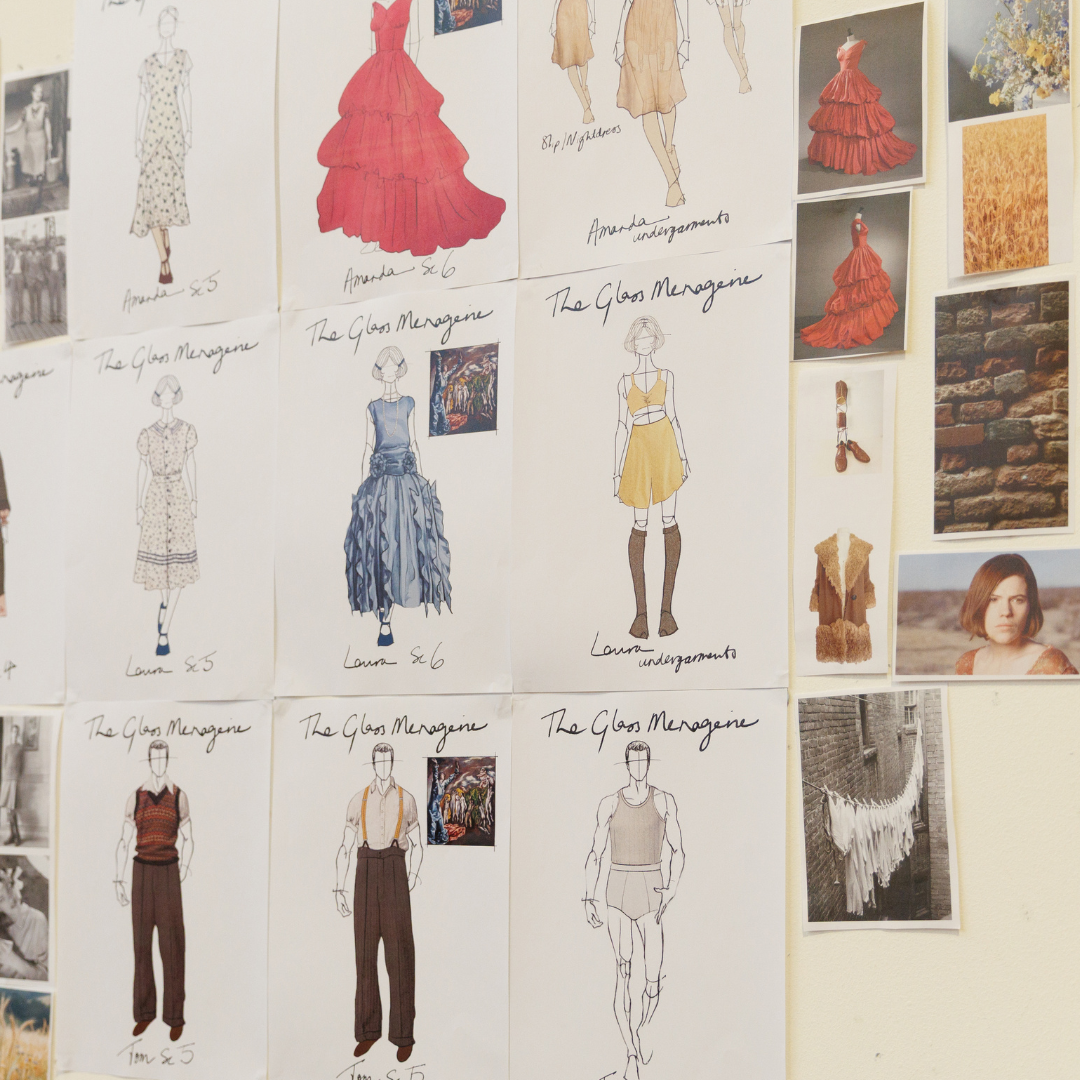
Woodroofe’s work across MTC productions – including The Glass Menagerie, Cost of Living and the upcoming ELIZA, beautifully demonstrates how costuming augments storytelling. “Audiences will make assumptions and have an emotional reaction to someone because of their costume,” she says. “So, it’s really important that the designer, director and actor are aligned in terms of the intention behind the character.”
People often tell Woodroofe that her job must be wonderful, imagining all the shopping and fittings. “Sometimes the things we do can seem a bit fanciful or unimportant. We might spend a long time talking about the exact colour of a pair of socks – heavy-hitting stuff. But actually, it kind of is. That level of analysis and attention to detail is what brings authenticity to a character. When we see people who feel real, or we recognise something of ourselves in them, it can help us understand the world around us and other people’s experiences.” Woodroofe uses design to draw audiences into the world of the play without being too conspicuous, but Gabi Havens’ work in hair and makeup is meant to be invisible to audiences entirely.
“When a wig feels authentic to the character, it disappears,” says Havens, MTC’s Hair, Wig and Makeup Designer. “It allows the audience to focus entirely on the story rather than the craftsmanship behind it. If an actor feels fully transformed, that carries into their performance.”
The craftsmanship behind that invisibility is profound. Each hair in a theatrical wig is knotted by hand, one hair per hole around the hairline, in a painstaking process that Havens describes as work she genuinely loves. “It’s slow, detailed work that requires a lot of patience.” Furthermore, during a season, wigs must be washed, restyled and repaired as a matter of course, as Havens prefers hers to move like natural hair with no style overly set or heavily sprayed.
The wig room – Havens’ HQ – is a calm and supportive space that “sees a range of moments, from funny jokes right through to vulnerability. It’s a space for actors to centre themselves before stepping on stage.” Those conversations, she says, often alter the work. “Sometimes a small detail about a character’s background, status or emotional journey will completely shift how I approach the texture, shape or how lived in or polished the wig should feel.”
For all four women, the question of what audiences take with them is one they return to, and they share the belief that stories told on the MTC stage are critical.
“My favourite theatre is when I leave feeling a little different to how I walked in,” says Sarks. “Theatre is one of the most empathetic art forms; it asks you to step inside the shoes of someone else and see the world differently. And there’s this beautiful fact that audiences’ hearts start to beat together while watching a show. I just find that incredibly special.”
Woodroofe, who has spent her career giving audiences characters to believe in, puts it simply: “I have a deep belief in the power of people, place and narrative. Stories help us understand ourselves and other people, and can deepen our connection with the world around us. For me, design always starts with the story.”
The village, in other words, builds something much larger than a production. It builds the conditions for a room full of strangers to sit in the dark together, hearts beating in time, and, for a few hours, feel like they’re part of something.
Melbourne Theatre Company mtc.com.au Southbank Theatre, 140 Southbank Boulevard, Southbank. Before I Forget by Kamarra Bell-Wykes plays at Melbourne Theatre Company end of 2026.